
What Does "Big-Rig Friendly" Mean at an Australian Caravan Park?
"Big-rig friendly" describes a park, not just a site. Here is what the label covers, what to measure, and how per-site length decides whether your rig actually fits.
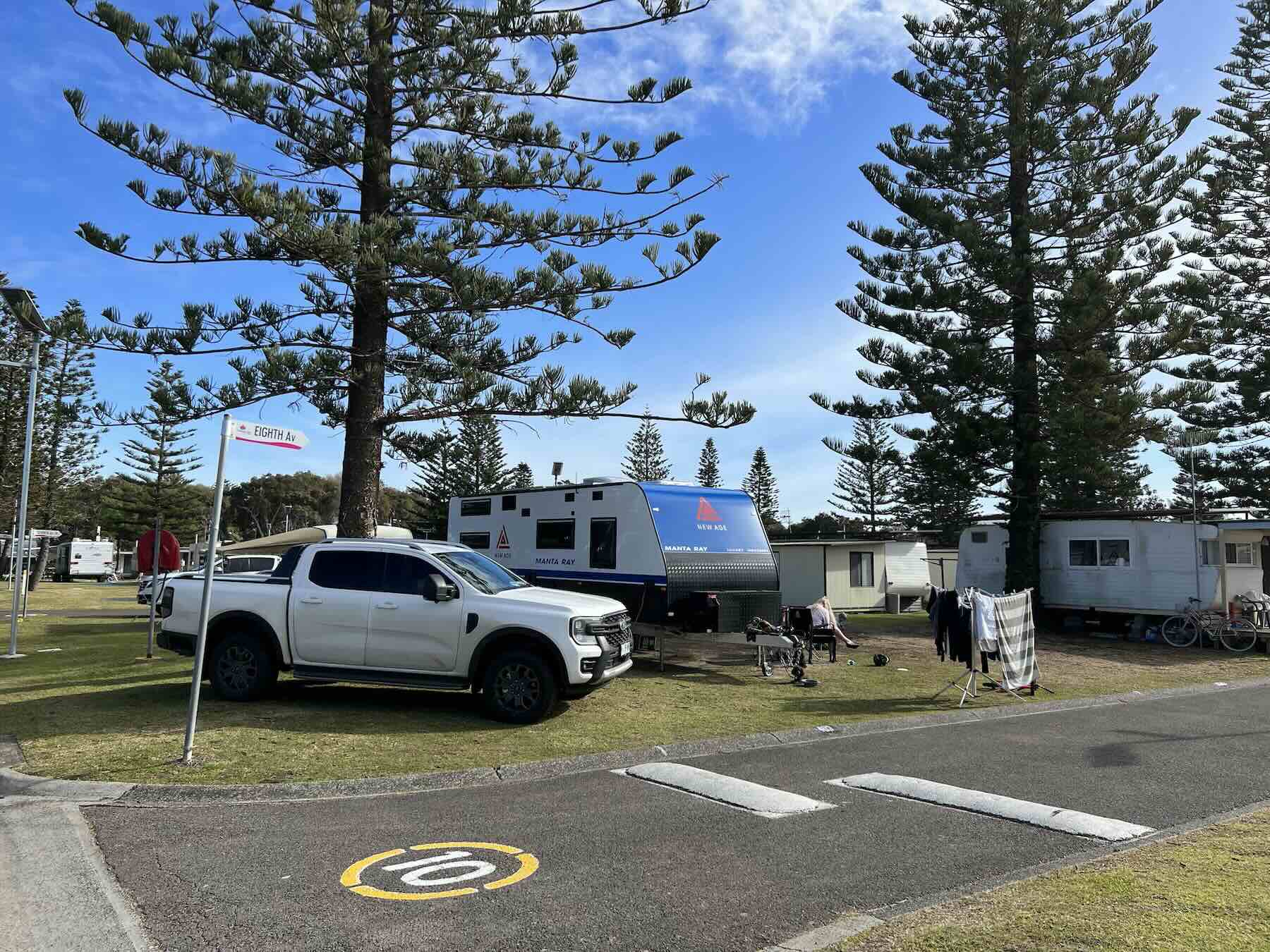
"Big-rig friendly" describes a park, not just a site. When a park uses the phrase, it is telling you that its layout suits long touring setups: internal roads with room to swing, sites long enough for a big van, often drive-through access, and an entry off the main road you can take without a three-point turn.
The number that decides whether you fit is the length of the individual site. A park can suit big rigs overall and still have only a handful of sites long enough for a 9 metre van behind a dual cab. That is why, on Total Parks, you enter your full rig length and bookable sites that cannot take it drop out of the results. The site, not the state or the park label, sets the limit.
Why a park-level tick is not enough
Almost every park has a site mix. The same address can hold 4 metre tent patches, standard 8 metre powered sites, and two or three long slabs that were laid when the park last reworked its layout. One label has to cover all of it, so it ends up describing the park's intent rather than the site you will be given.
The label also carries no scale. A park with a dozen 12 metre drive-throughs and a park with one long site at the back fence can both reasonably describe themselves as suiting big rigs. Nothing in the phrase separates them, and nothing in it tells you whether the long one is the site you are about to book.
That is the gap the measurements close. Total Parks keeps individual site lengths in a national database of normalised site dimensions, held in metres, so a 10 metre site means the same thing in Eden as it does in Echuca.
What to measure before you search
Work in metres, and measure the rig rather than trusting the badge on the side.
- Measure overall length, not body length. Australian caravans are usually advertised by body or model size, which leaves out the drawbar. The gap is bigger than most people expect: Caravan World's review of the Supreme Executive records a van sold as 19 ft 6 in with a 6.3 metre body and an 8.5 metre overall length.
- Include what hangs off the back. A bike rack, spare wheel carrier, or rear bar storage box all add to the length that has to fit between the pegs.
- Add the tow vehicle if you stay hitched. Fifth-wheelers and anyone who would rather not unhitch for a one-night stop should measure the whole combination, front bumper to rear bumper.
- Know your unhitched number too. If you drop the van and park the car beside it, the van alone is what the site needs to take, and the car needs somewhere to go.
Advertised sizes are still quoted in feet at most dealers, so here is the conversion for the common ones. Remember these are body sizes: your overall length will be longer.
| Advertised van size | Body length in metres |
|---|---|
| 18 ft | 5.5 m |
| 20 ft | 6.1 m |
| 22 ft | 6.7 m |
| 24 ft | 7.3 m |
| 26 ft | 7.9 m |
If you are working through weights and dimensions for a new setup, the National Recreational Vehicle Towing Guide, published through the Caravan Industry Association of Australia, is the standard Australian reference.
Drive-through or back-in is about access, not length
These two ideas get folded together, and they answer different questions.
Drive-through means you can enter one end of the site and leave from the other without reversing. That is an access feature, and it is the one that makes a long day end calmly.
Length is what determines whether the rig physically fits. Some drive-through sites are short. Some back-in sites are the longest in the park. A park that advertises drive-through access has told you something useful about manoeuvring and nothing at all about metres.
Both matter, and they are answered differently. Length is filtered for you once you enter your rig. Drive-through access is only ever as good as what the park has written down, so read the site name and description and assume you will be reversing in unless one of them says otherwise.
How to use Total Parks with a long rig
Enter your full rig length once, then search. Bookable sites that cannot take that length are filtered out, so you are choosing between options that fit rather than reading site descriptions and estimating.
Access is the part you still read for yourself. Names and descriptions such as "Drive-Through Powered Site", "Big Rig", or "Slab" tell you what the park has gone to the trouble of labelling. Where nothing mentions drive-through, plan on backing in, because a site that is not labelled drive-through usually is not one.
One distinction worth holding on to: the physical length on a listing is not the same as a dated booking. Length tells you the site exists and how long it is. Your dates tell you whether it is yours for those nights.
How the big-rig collections are put together
We keep two state collections of long-site parks, and they are built to different standards. Worth knowing which you are reading.
Victoria is the verified list. Every park on it has at least one site recorded at 10 metres or longer on Total Parks. There is no fallback, so a park that describes itself as big-rig friendly but has no site lengths recorded does not appear, even if it would suit you.
New South Wales prefers the same recorded site lengths, and most of the list is built on them. It also still includes some parks that have marked big-rig, drive-through, or long-slab options, so the collection stays useful along the Pacific and Princes corridors while more site measurements come online. The NSW page carries a note explaining that mix.
Ten metres is the threshold for getting onto those lists, not a guarantee about your stay. A park earns its place because at least one of its sites is long enough. Which site that is, and whether it is free on your dates, is what your search answers.
Where a park has no recorded site lengths, it stays off the verified list until the measurements come through, rather than being rounded up on the strength of the label.
Where to go next
- Big-rig-friendly holiday parks in NSW – the Pacific and Princes Highway runs, plus the inland routes.
- Big-rig-friendly holiday parks in Victoria – the verified long-site list, from the Great Ocean Road to the Murray.
- Best big-rig caravan parks on the East Coast – region-by-region detail on access, slabs, and where the space is.
- What is a powered site? – the other term that trips people up on a booking page, including what 15-amp supply actually runs.
Once you are working in metres and thinking about the site rather than the park, the whole question gets smaller. Measure the rig, enter the number, and let the short sites take themselves out of the running.
Frequently asked questions
Is "big-rig friendly" an official rating?
No. It is a phrase parks use to describe their own layout, not a graded standard with a set length behind it. Treat it the way you would treat "family friendly": useful for building a shortlist, not a measurement. The measurement that matters is the length of the individual site you book, which is why Total Parks holds site lengths in metres and filters your search against the rig length you enter.
What length actually counts as a big rig in Australia?
There is no single cut-off, and parks draw the line in different places. Total Parks uses 10 metres as the marker for its big-rig collections, so a park qualifies when at least one of its sites is recorded at 10 metres or longer. In practice, the moment your van plus tow vehicle passes about that mark, the number of sites that suit you at any given park starts to shrink.
Should I enter the length of the van or the van plus the car?
Enter whatever will be sitting on the site. If you stay hitched, that is the tow vehicle and the van together, measured from the front of the car to the back of the van. If you unhitch and park the car alongside or in visitor parking, the van on its own is the number the site has to take. Motorhome travellers measure the vehicle itself, including anything mounted on the rear.
If a park has a 10 metre site, is my rig guaranteed to fit on my dates?
No, and it is worth separating the two questions. Site length is a physical description, so it tells you the park has at least one site that could take a long rig. Whether that particular site is open for your dates is a different question, answered when you put your dates and your rig length into a search on Total Parks.
NSW parks with longer sites for fifth-wheelers, motorhomes, and 20-foot-plus caravans. Enter your full rig length and see what fits.
Browse Big-Rig-Friendly NSW ParksEnjoyed this article? Follow @totalparks for weekly camping tips and park spotlights.